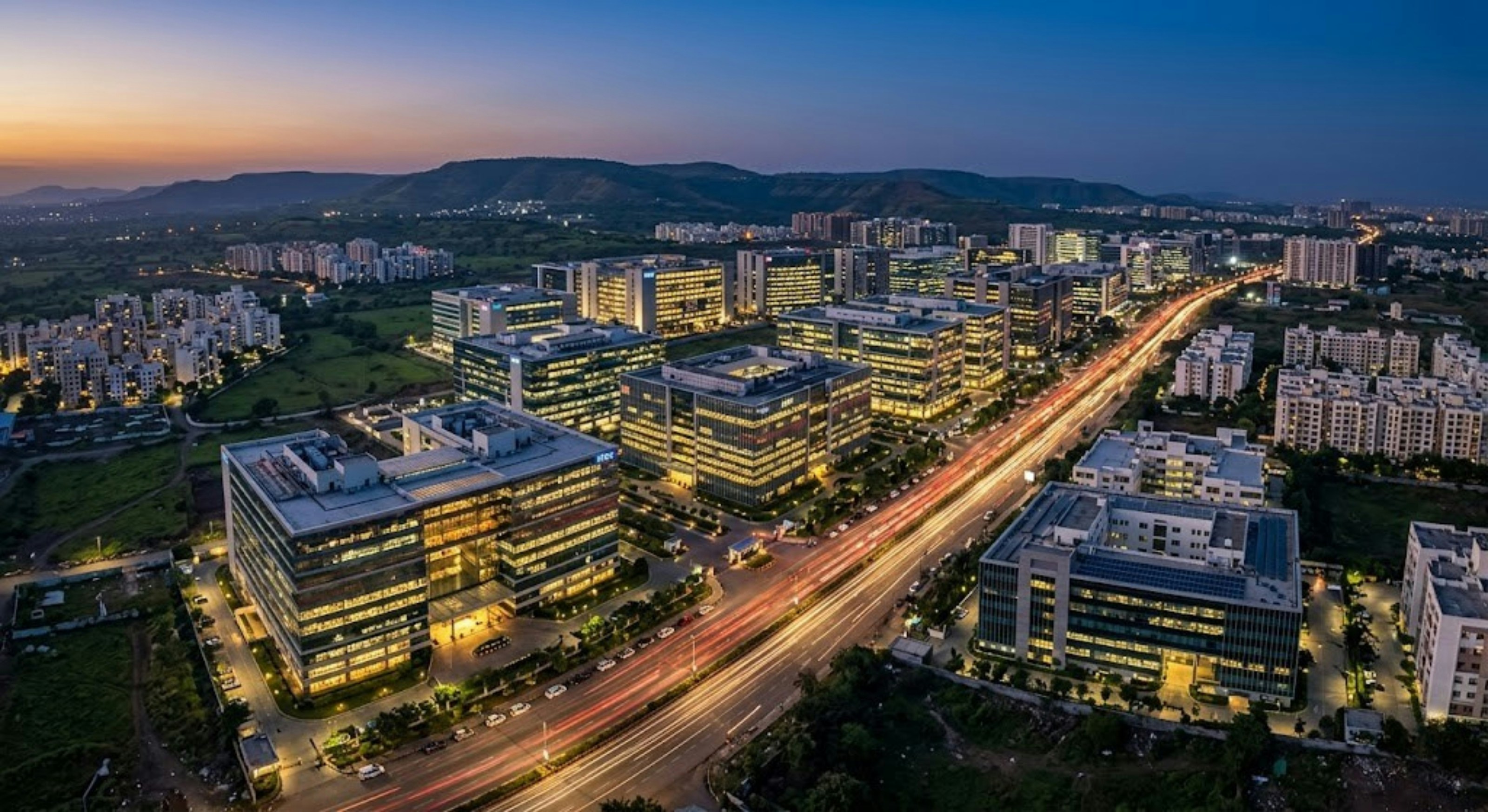
What is an Integrated Information Technology Park (IITP)?
India's IT sector grew up in purpose-built campuses — enclosed, car-dependent, and disconnected from the cities around them. A software park in the 1990s was essentially a walled precinct: an office building, a cafeteria, and a car park. Workers commuted in. The city provided nothing else for them.
UDCPR 2020 articulates a different vision through Regulation 14.10 — the Integrated Information Technology Park (IITP). The word "integrated" is not incidental. An IITP is not merely an IT park with additional FAR. It is a self-contained township — a planned environment that combines IT workspaces with residential accommodation, retail and commercial uses, hospitality, civic amenities, and open spaces in defined proportions on a single large plot.
The idea is to create live-work-play environments where IT professionals can live within the same development as their workplace, supported by schools, hospitals, retail, and recreation. For developers and planners, the IITP framework offers a high-FSI, multi-use development model that is eligible for additional density precisely because it is integrated and planned.
Primary reference: Unified Development Control and Promotion Regulations for Maharashtra State, approved by Government of Maharashtra, Urban Development Department, 2 December 2020. Regulation 14.10 governs Integrated Information Technology Parks (IITP).
Eligibility Criteria for IITP
Not every IT park qualifies as an IITP under UDCPR. The regulation sets out minimum thresholds that a project must meet before it can be processed and approved under the IITP framework. Meeting these thresholds is a prerequisite — not a guarantee — for the additional FSI and other entitlements the framework offers.
| Eligibility Parameter | Minimum Requirement | Notes |
|---|---|---|
| Minimum project area | 10 acres (approx. 4 hectares) | Must be a contiguous parcel or parcels assembled under a single development entity |
| Primary use component | IT and IT-enabled services (IT/ITES) and support services buildings | Must constitute the dominant use by area; support services directly serving IT operations are included |
| Integrated development requirement | Must include residential, commercial, amenity, and open space components in the prescribed mix | The mix is prescribed under Reg. 14.10; a pure IT park without integration does not qualify |
| Project proponent | Developer, company, or consortium registered and eligible under the applicable Maharashtra government notifications for IT township development | Government approvals and registrations required before processing under IITP framework |
| Eligibility conditions, minimum area thresholds, and permissible uses are subject to Government of Maharashtra notifications issued under the IITP framework. Confirm current conditions with the applicable planning authority before proceeding. | ||
The integration requirement is non-negotiable
A project that proposes only IT buildings on a large plot does not qualify as an IITP. The UDCPR framework requires a genuine multi-use township with residential accommodation for IT workers, civic amenities, hospitality, retail, and open spaces — each in defined proportions. This is what earns the additional FSI premium. If the project does not integrate these uses at the planning stage, it cannot be processed under Regulation 14.10.
Permissible Land Use Mix in an IITP
The IITP framework under UDCPR 14.10 prescribes a specific mix of land uses that must be maintained within the overall project area. This mix is not optional — it defines what an IITP is and distinguishes it from a conventional IT park or a mixed-use development.
| Land Use Component | Description | Development Requirement |
|---|---|---|
| IT / IT-enabled services and support services | Primary income-generating component: software development, data centres, BPO, KPO, and support services directly serving IT operations | Must be the dominant use; forms the basis of the IITP designation |
| Residential | Housing for IT workers and their families within the township boundary | Mandatory integrated component; ensures live-work character |
| Commercial and retail | Shops, restaurants, business centres, and commercial services supporting the township population | Support use; must be planned to serve the township and not independently attract external traffic to the extent of dominating the character |
| Hospitality | Hotels and serviced apartments for business visitors and short-term residents | Permitted support use; subject to area caps under UDCPR |
| Amenities, facilities, and utilities | Schools, healthcare, worship, parks, sports facilities, and civic infrastructure | Must be developed phase-wise simultaneously with the IT and residential components; earmarked plots must be developed along with each phase |
| Open spaces and landscaping | Parks, green corridors, recreational open spaces | Mandatory as per UDCPR open space norms; integration into the township master plan is required |
| The precise percentage breakdown of each use within the total project area is specified under Regulation 14.10 of UDCPR 2020 and applicable Government of Maharashtra notifications. Confirm the current permissible mix with the planning authority at the time of project processing. | ||
Basic Infrastructure Requirements
One of the most important and legally binding aspects of the IITP framework under UDCPR is the infrastructure-first mandate. Under Regulation 14.10.12, no sale of plots or flats within an IITP may be permitted unless the developer has first provided the basic infrastructure to the satisfaction of the planning authority.
This is not a procedural formality — it is a condition precedent to sale. Understanding what "basic infrastructure" means in the IITP context is essential for project planning, phasing, and cash flow management.
| Infrastructure Category | Components | Timing Requirement |
|---|---|---|
| Roads and access | Internal road network, vehicular and pedestrian access, entry/exit points, ramps | Must be provided before sale permission is granted for any phase |
| Water supply | Water connection, internal distribution network, storage | Phase-wise with development |
| Sewerage and drainage | Underground sewerage, storm water drainage, STP where required | Phase-wise with development |
| Power supply | Electrical infrastructure, substations, internal distribution, DG backup | Phase-wise with development |
| Amenity plots | Schools, healthcare, parks, civic uses — earmarked and developed | Must be simultaneously developed phase-wise along with IT / support services; cannot be deferred to a later phase |
| Telecommunications | Fibre optic conduit, communication infrastructure backbone | Essential for IT use; typically integrated with road infrastructure |
| The planning authority has the final say on what constitutes "basic infrastructure" for the purposes of Regulation 14.10.12. The developer must submit an undertaking to the authority specifying infrastructure to be completed phase-wise before any phase-wise sale permission is granted. | ||
Amenity plots cannot be developed later. Under Regulation 14.10.12, plots earmarked for amenities, facilities, and utilities must be developed simultaneously with the IT and support services component — phase-wise. This means a developer cannot complete the IT buildings and residential towers first and defer the school, hospital, or park to the final phase. Non-compliance may result in sale permission being withheld.
FSI Entitlements and Premium Payment
The IITP framework under UDCPR 2020 offers additional FSI (Floor Space Index) over and above the base FSI permitted for the zone. This additional FSI is conditional on the integrated development requirement being met, the applicable premium being paid, and the planning authority approving the IITP proposal.
Additional FSI and Premium
The additional FSI available to an IITP project is subject to payment of a premium to the planning authority. The quantum of additional FSI and the premium rate are specified in UDCPR Regulation 14.10.11 and the applicable Government of Maharashtra notifications. Confirm the current rates with the planning authority at the time of project processing, as these may be revised by Government Resolution.
Staggered Payment Facility (Regulation 14.10.11(1)(f))
One of the developer-friendly provisions in the IITP framework is the staggered payment option for the additional FSI premium. Under Regulation 14.10.11(1)(f):
Staggered Premium Payment — Regulation 14.10.11(1)(f)
The premium payable for additional FSI in an IITP may be paid in two installments. The entire premium must, however, be paid within one year of the date of the first installment, or on the date of obtaining the Occupancy Certificate or Part Occupancy Certificate, whichever is earlier.
| Payment Parameter | Condition |
|---|---|
| Number of installments permitted | Two installments |
| Maximum payment timeline | Within one year of the first installment |
| Outer deadline | Date of Occupancy Certificate or Part Occupancy Certificate, whichever is earlier than the one-year limit |
| Effect of non-payment by deadline | Confirm with planning authority; delays may attract interest or affect permission validity |
| The staggered payment facility applies specifically to the premium for additional FSI under Regulation 14.10.11(1)(f). It does not relieve the developer of the obligation to pay development charges, other levies, or fees on time as required by the planning authority. | |
Urban Land (Ceiling and Regulation) Act Exemption
IITP projects are eligible to be exempted from the purview of the Urban Land (Ceiling and Regulation) Act, 1976. This exemption, where applicable, removes one of the historical legal constraints on large-scale land assembly for IT township development. The exemption is not automatic and must be applied for and obtained through the applicable government process. Confirm the current status and procedure with the planning authority and legal advisors.
Sale Permission — Regulation 14.10.12
Regulation 14.10.12 establishes a strict infrastructure-first discipline on the developer's ability to sell plots and flats within an IITP. This provision has direct implications for a developer's sales strategy, marketing timeline, and project cash flow model.
Regulation 14.10.12 verbatim intent: It is obligatory on the part of the developer to first provide basic infrastructure. No permission for sale of plot or flat shall be allowed unless the basic infrastructure is provided by the developer to the satisfaction of the Authority.
How Sale Permission Works in Phased IITP Development
For large IITPs developed in phases, the sale permission regime operates phase by phase:
- Developer submits undertaking: Before any phase-wise sale permission is sought, the developer must submit an undertaking to the planning authority specifying the basic infrastructure to be provided for each phase and the timeline for completion.
- Phase-wise infrastructure completion: The authority grants sale permission for a phase only after the basic infrastructure for that phase is completed to its satisfaction.
- Amenities developed simultaneously: Plots earmarked for amenities, facilities, and utilities must be developed along with the IT and support services component of each phase. They cannot be left for later phases.
- Authority discretion: The planning authority retains discretion to withhold or qualify sale permission pending satisfactory completion of infrastructure. Developers should factor this into their sales launch timelines and agreements with buyers.
Cash flow implication for developers
The infrastructure-first rule under Regulation 14.10.12 means that a developer cannot rely on early sales revenue to fund basic infrastructure. The infrastructure must be provided — or at least be in a state satisfactory to the authority — before the sales pipeline opens. This front-loads capital expenditure significantly and requires developers to arrange construction finance for the infrastructure component before project sales commence.
Implementation and Completion — Regulation 14.10.13
UDCPR Regulation 14.10.13 prescribes the timeline within which an IITP must be completed. Unlike conventional developments where timelines are tracked informally, the IITP framework creates a regulatory obligation with defined periods and an extension mechanism.
| IITP Area | Completion Period | Extension |
|---|---|---|
| 10 acres (4 Hec.) to 25 acres (10 Hec.) | 7.5 years from date of approval | Extension may be granted with approval of the Committee constituted for this purpose |
| More than 25 acres (10 Hec.) | 10 years from date of approval | Extension may be granted with approval of the Committee constituted for this purpose |
| In case of delay beyond the prescribed period, the developer must apply to the designated Committee for an extension. Extensions are not automatic. The consequences of delay without approved extension should be confirmed with the planning authority and legal advisors before project commitment. | ||
Extensions are not guaranteed. Regulation 14.10.13 states that extensions may be granted "with the approval of the Committee constituted in this regard." This implies a formal application and review process. Developers must not assume that a completion timeline extension will be granted as a matter of course. Build conservative timelines into project agreements with landowners, investors, and buyers.
Interpretation of IITP Regulations — Regulation 14.10.14
Given the complexity and multi-use nature of the IITP framework, Regulation 14.10.14 provides a formal dispute resolution and interpretation mechanism. If any question or dispute arises with regard to the interpretation of the IITP regulations:
- The matter is to be referred to the State Government by the planning authority or any aggrieved party.
- The Government, after considering the matter and, if necessary, after giving a hearing to the parties, shall give a decision on the interpretation.
- The decision of the State Government on the interpretation of these regulations is final and binding on all concerned.
Practical implication for developers and architects
The interpretation mechanism in Regulation 14.10.14 is significant because IITP projects are large, long-gestation developments where regulatory ambiguity can have major financial consequences. If a planning authority takes a position on an IITP provision that the developer disputes, the formal remedy is referral to the State Government — not litigation in the first instance. Developers should document all communications with the planning authority and seek written confirmation of interpretations before relying on them in project planning.
How IITP Norms Affect Project Feasibility
The IITP framework is designed to incentivise large-scale, high-quality IT township development through additional FSI. But the framework comes with obligations that significantly shape how a project must be structured, financed, and delivered. Understanding these implications at the feasibility stage — before land acquisition or commitment — is essential.
Minimum Scale Constraint
The 10-acre minimum means IITP eligibility is not available to smaller IT park developments. Developers or landowners with plots below 10 acres must either assemble additional land or develop under conventional IT park norms without the IITP FSI entitlement.
Multi-Use Complexity
An IITP master plan must simultaneously plan for and commit to IT, residential, commercial, hospitality, and amenity components in defined proportions. Each use has different market dynamics, construction types, buyer profiles, and regulatory requirements. Managing multi-use complexity adds to design, procurement, and project management cost and time.
Infrastructure Front-Loading
The sale permission restriction under Regulation 14.10.12 means the developer cannot use early sales collections to fund infrastructure. This front-loads capital expenditure and requires construction finance for infrastructure before the sales engine starts. Projects must be modelled with this capital requirement explicitly funded at project commencement.
Long Completion Timelines
7.5 to 10 years is a long development horizon. Projects that are feasible at today's costs and revenues may face very different conditions mid-project. Feasibility models must stress-test construction cost escalation, revenue delay, and market cycle risk over the full development period.
Amenity Obligation
Amenity plots must be developed simultaneously with IT and residential components. In many projects, amenity components such as schools and hospitals are loss-making or at best break-even for the developer. The cost of developing amenities as part of the IITP package must be included in the project feasibility model — not deferred or assumed to be absorbed by a third-party operator without prior arrangement.
IITP is a long-horizon commitment — price it accordingly
The additional FSI that the IITP framework offers is real and significant. But so is the developer's obligation: to deliver a genuine integrated township — with roads, water, sewerage, power, schools, healthcare, parks, and retail — before the sales pipeline opens. Projects that are modelled on the FSI upside without pricing the infrastructure obligation fully will underperform at execution. Comprehensive feasibility analysis before land commitment is not optional; it is the foundation of viable IITP development.
Common Mistakes in IITP Planning
- Treating IITP as a high-FSI IT park without integration. The additional FSI is earned by genuine multi-use integration. A project that is primarily IT buildings with a notional residential component does not meet the spirit or the letter of Regulation 14.10.
- Deferring amenity development to the last phase. Regulation 14.10.12 requires amenity plots to be developed simultaneously with IT and residential components, phase by phase. This is not negotiable.
- Planning for sales revenue to fund basic infrastructure. The infrastructure-first rule means sales cannot commence until infrastructure is in place. Projects must be capitalised to cover infrastructure costs without relying on buyer payments.
- Underestimating completion timeline risk. A 7.5- or 10-year completion horizon is subject to construction risk, market cycles, regulatory changes, and force majeure. Extension is not guaranteed. Model conservatively.
- Not confirming the exemption from Urban Land Ceiling Act. The ULCA exemption for IITP projects is not automatic. It must be applied for and obtained. Failure to confirm this can delay land assembly or create legal complications.
- Misreading the staggered premium payment window. The two-installment facility for the additional FSI premium must be fully paid within one year or by the Occupancy Certificate date — whichever is earlier. Missing this deadline can have serious consequences for the project's permissions.
- Proceeding without written confirmation from the planning authority on interpretation. IITP regulations are complex and subject to periodic amendment by Government Resolution. If any provision is ambiguous, obtain written confirmation from the authority — and if necessary, invoke the State Government interpretation mechanism under Regulation 14.10.14.
Frequently Asked Questions
What is an Integrated Information Technology Park (IITP) under UDCPR?
An Integrated Information Technology Park (IITP) under UDCPR 2020 Regulation 14.10 is a large-scale planned development that combines IT and IT-enabled services workspaces with residential accommodation, commercial uses, hospitality, civic amenities, and open spaces on a contiguous plot of minimum 10 acres (4 hectares). It is not a conventional IT park — it must be genuinely integrated and must include the full range of uses in the proportions prescribed under UDCPR. The framework offers additional FSI over the base zone FSI in return for this integrated, township-level development commitment.
What is the minimum area for an IITP under UDCPR?
The minimum area for an IITP under UDCPR 2020 is 10 acres (approximately 4 hectares). Projects between 10 acres and 25 acres must be completed within 7.5 years of approval. Projects above 25 acres (10 hectares) have a completion timeline of 10 years. There is no prescribed upper limit on IITP area — larger projects benefit from the 10-year timeline but must manage the additional complexity of multi-phase delivery over a longer horizon.
Can the FSI premium for an IITP be paid in installments?
Yes. Under UDCPR Regulation 14.10.11(1)(f), the premium for additional FSI in an IITP may be paid in two installments. The entire premium must be paid within one year of the first installment, or by the date of obtaining the Occupancy Certificate or Part Occupancy Certificate — whichever is earlier. The staggered payment facility provides some cash flow relief, but the outer deadline is strictly tied to the OC date. Developers must ensure the premium is fully paid before the certificate is obtained.
When can plots or flats in an IITP be sold?
Under UDCPR Regulation 14.10.12, no sale of plots or flats in an IITP is permitted until the developer has first provided basic infrastructure to the satisfaction of the planning authority. In phased projects, the developer must submit an undertaking specifying phase-wise infrastructure and can obtain sale permission for each phase after the basic infrastructure for that phase is completed. Amenity plots must be developed simultaneously with IT and residential components in each phase — they cannot be deferred.
What is the completion timeline for an IITP under UDCPR?
Under UDCPR Regulation 14.10.13, an IITP between 10 acres and 25 acres must be completed within 7.5 years of approval. An IITP above 25 acres must be completed within 10 years. If a project is delayed beyond the prescribed period, an extension may be sought from the Committee constituted for this purpose — but extensions are not automatic and must be applied for and approved. Developers should build conservative timelines into project agreements to account for construction risk and regulatory changes over a long development horizon.
Are IITP projects exempt from the Urban Land Ceiling Act?
IITP projects under UDCPR are eligible to be exempted from the purview of the Urban Land (Ceiling and Regulation) Act, 1976. However, this exemption is not automatic. It must be applied for and obtained through the appropriate government process. Developers assembling large land parcels for an IITP project should confirm the exemption status and application procedure with the applicable planning authority and legal advisors before finalising land acquisition commitments.
Who resolves disputes about IITP regulation interpretation?
Under UDCPR Regulation 14.10.14, any question or dispute about the interpretation of IITP regulations is to be referred to the State Government. The Government, after considering the matter and if necessary after hearing the parties, gives a decision. That decision is final and binding on all concerned. Developers who face regulatory ambiguity or a dispute with the planning authority over an IITP provision should document the issue clearly and seek formal clarification through this mechanism rather than proceeding on an informal or assumed interpretation.
What does phase-wise development mean in an IITP?
In an IITP, phase-wise development means the overall project is delivered in defined stages, each with its own infrastructure and use components. For each phase, the developer must complete the basic infrastructure before obtaining sale permission for that phase. Critically, the amenity plots (schools, hospitals, parks, utilities) earmarked for each phase must be developed simultaneously with the IT and residential components of that phase — not deferred to a later stage. The developer must submit an undertaking to the planning authority detailing the phase-wise infrastructure plan before seeking any phase-wise sale permission.
Evaluate Your IITP or IT Park Project Feasibility on FSI Atlas
Before committing to land acquisition or finalising an IITP proposal, the full development model must be stress-tested — covering FSI entitlements, infrastructure costs, phasing, cash flow, and completion risk. FSI Atlas helps architects, developers, and consultants run preliminary feasibility for Maharashtra projects in under five minutes.
References and Sources
The IITP norms in this article are sourced from the following primary documents:
- Unified Development Control and Promotion Regulations for Maharashtra State — Government of Maharashtra, Urban Development Department, approved 2 December 2020, and subsequent amendments. Regulation 14.10 governs Integrated Information Technology Parks (IITP).
- Maharashtra Regional and Town Planning Act, 1966
- Urban Land (Ceiling and Regulation) Act, 1976 — relevant to IITP land assembly exemptions
- Government of Maharashtra notifications and GRs issued under the IITP framework — verify the latest with the applicable planning authority before finalising IITP proposals
Disclaimer
This is a simplified preliminary guide to IITP norms under UDCPR 2020. Final IITP development conditions, FSI entitlements, premium rates, and approval procedures must be verified with the latest UDCPR, local authority circulars, applicable Government Resolutions, and a qualified architect or consultant. Regulations may be amended. Authority-specific conditions apply. This article is for educational and feasibility guidance only and does not constitute legal or professional advice.
