When you check FSI on a CIDCO plot, the starting question is not what is the FSI but what kind of CIDCO plot is this. A normal tender plot, a 12.5% GES compensation plot, a 22.5% airport rehabilitation plot, a Pushpak Node plot and a JNPT scheme plot all sit inside the same CIDCO conversation — but each carries a different FSI number under UDCPR Clause 10.14. Getting the wrong one can mean underbuilding, overbidding on land price, or a building plan that gets rejected at the authority stage.
The 22.5% scheme, for example, exists because of Navi Mumbai International Airport. Nearly 3,000 households across 10 villages — Chinchpada, Kopar, Kolhi, Ulwe, Varche Owale, Waghivalivada, Ganeshpuri, Targhar, Kombadbhuje and Vaghivali — were displaced when the core airport area of 1,161 hectares was cleared. Under the Right to Fair Compensation Act 2013, CIDCO offered these Project Affected Persons (PAP) 22.5% of their acquired land as developed plots. The State Government approved the Rehabilitation and Resettlement policy by GR dated 1 March 2014. Resettlement pockets were created at Vadghar (along SH-54), Vahal in Ulwe Node (Sectors 24, 25 and 25A), and Pushpak Nagar — a new 14th node township of about 222 hectares near the airport on NH-4B — where plots were allotted through a computerised lottery conducted in August and September 2014. Each of these plots now carries the FSI and use conditions set under Clause 10.14.2, not the normal CIDCO tender-plot rules.
This article walks through each scheme in plain language — what it is, who it applies to, what FSI it carries, and what to check before calculating buildable area on any CIDCO plot.
CIDCO Area Excluding NAINA: What Clause 10.14 Means
UDCPR Clause 10.14 deals with CIDCO areas excluding NAINA area. In simple words, it says that selected CIDCO-linked provisions from Clause 10.10 continue to apply to CIDCO areas, and it separately gives special FSI rules for land compensation and rehabilitation pockets in Navi Mumbai.
This distinction matters because people often use the words CIDCO, NAINA, Panvel and Navi Mumbai loosely. For FSI calculation, that can be dangerous. A plot may be under CIDCO DCR, NAINA DCPR, Panvel Municipal Corporation, or a CIDCO SPA reference depending on its exact location, village, survey number, allotment document and development plan status.
Primary clause reference: UDCPR Clause 10.14, 10.14.1, 10.14.2 and 10.14.3. NAINA is a separate planning framework and should be checked through the applicable NAINA DCPR provisions.
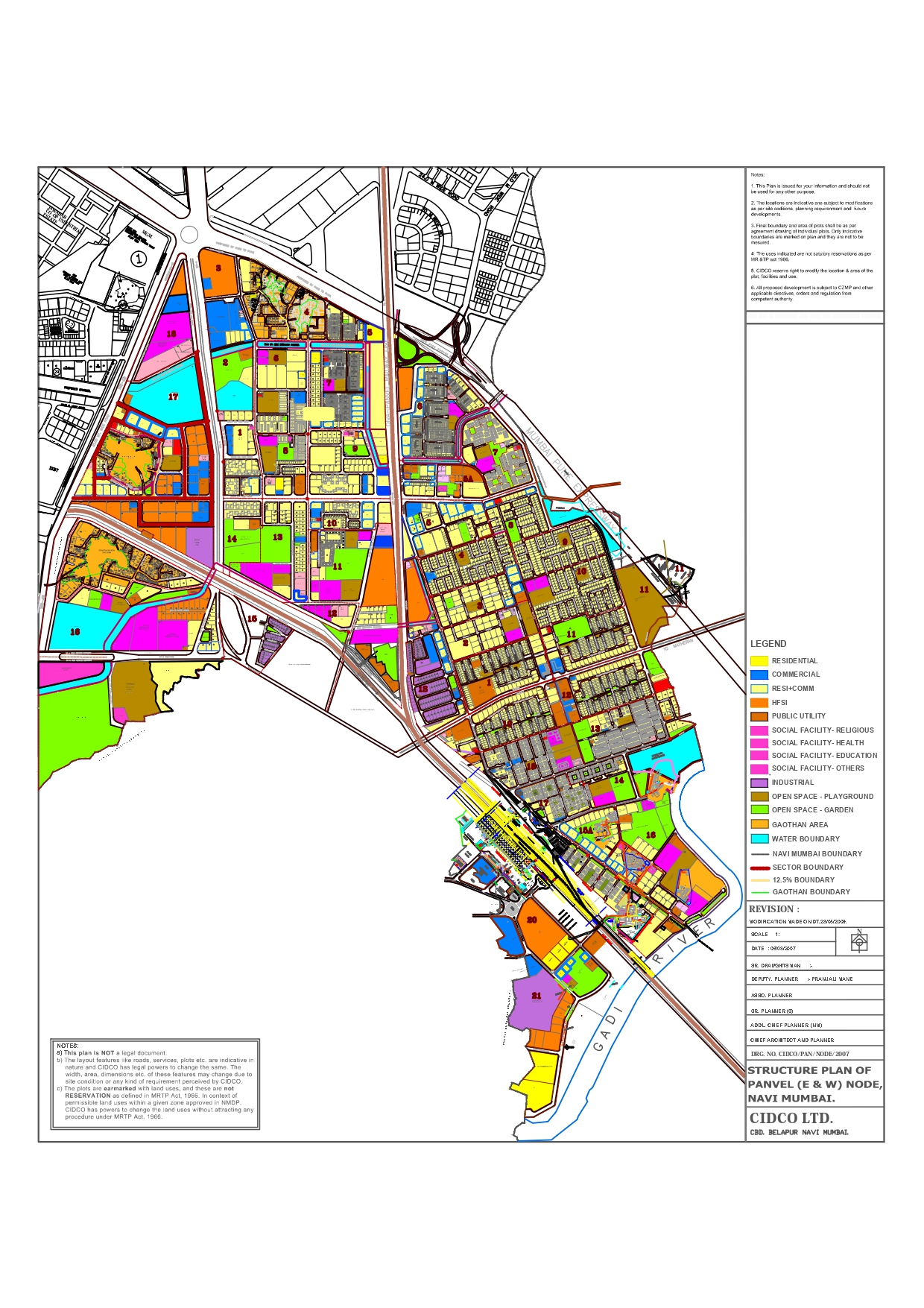
Why CIDCO plot FSI is confusing
A normal CIDCO tender plot, a 12.5% GES (Gaothan Expansion Scheme) plot, a 22.5% land compensation plot, a rehabilitation-pocket plot, a JNPT 12.5% scheme plot and a Pushpak Node plot can all sit inside the broader CIDCO conversation, but they do not produce the same FSI answer.
The correct input is usually hidden in the allotment letter, lease document, CIDCO correspondence, DP remark, village/survey record or acquisition/rehabilitation history. That is why the allotment type and source document must be checked separately for each plot — one flat "CIDCO FSI" number does not exist.
Clause 10.14.1: CIDCO Areas Continue to Use Selected 10.10 Rules
Clause 10.14.1 says that Regulations 10.10.1, 10.10.2, 10.10.3, 10.10.4, 10.10.5 and 10.10.6 shall be applicable to CIDCO area. In practice, this means CIDCO area calculations may still depend on rules such as mixed-use conditions, redevelopment entitlement, road-width treatment, amenity-space treatment and other CIDCO/NMMC-linked provisions.
For example, the mixed-use rule under Clause 10.10.1 can affect whether the special business/mixed-use basic FSI benefit applies. Redevelopment under Clause 10.10.2 is a different calculation again, because it depends on tenements, carpet area, LR/RC ratio, rehab entitlement and incentive FSI.
CIDCO 12.5% Scheme: PAP, Net Plot and FSI
PAP means Project Affected Person. In the CIDCO context, it generally refers to a person or land holder affected by acquisition of land for CIDCO / Navi Mumbai development. The 12.5% scheme was introduced as a rehabilitation and compensation measure so that affected land holders receive developed land instead of only monetary compensation.
Under the 12.5% scheme, the broad idea is that a PAP gets developed land equal to 12.5% of the acquired land. From that entitlement, 30% area is used for roads, open spaces, social facilities and public utilities. So the practical net return works out to about 8.75% of the acquired land.
CIDCO's official 12.5% scheme page states that these plots get 1.5 FSI with permission for commercial use up to 15%. It also states that GES (Gaothan Expansion Scheme) project-affected persons can get this benefit, and that the PAP may develop the plot on their own or through an agreement with a developer.
For buyers, developers and architects, this is the most important practical point: do not treat a 12.5% PAP / GES plot as a normal tender plot. Its land history, allotment conditions, transfer permissions, lease terms and commercial-use cap should be checked before feasibility or purchase.
Current-status note: CIDCO's official website still shows the 12.5% scheme page, online 12.5% application links, allotment-status links and lottery-result links up to 2026. That suggests the scheme is still active for eligible / pending PAP administration, but it should not be read as a fresh open scheme for any ordinary plot owner.
Clause 10.14.2: Land Compensation Scheme and Rehabilitation Pocket
Clause 10.14.2 covers land compensation and rehabilitation pockets in Navi Mumbai. It refers to a CIDCO scheme approved by Government Resolution dated 1 March 2014 and amended from time to time, for compensating land holders whose lands are acquired on or after 1 March 2014.
The compensation scheme has three components. Each component has its own FSI treatment and its own practical implications for a feasibility report.
In simple words, this clause is not only about buying a normal CIDCO plot. It is mainly about land owners or affected persons who receive developed land or a developed plot because their original land or house is acquired. That is why the allotment document matters more than the public name of the location.
For Component I and Component II, the clause also mentions deduction of 30% of the eligible area for infrastructure and amenities before allotment of developed land. This is a land-allotment mechanism. For feasibility, use the final net plot area available after this deduction, and apply the applicable component FSI to that net area.
| Clause / Scheme | Plain-language meaning | Admissible FSI | Commercial-use condition |
|---|---|---|---|
| Component I | 10% developed land in lieu of monetary compensation, after deduction for infrastructure and amenities | 2.50 | Commercial use up to 15% of FSI, if otherwise permissible under UDCPR |
| Component II | 12.5% developed land in lieu of monetary compensation | 1.50 | Commercial use up to 15% of FSI, if otherwise permissible under UDCPR |
| Component I + II | Total developed land allotment of 22.5% | 2.00 | Since it combines Component I and II, keep the same 15% commercial-use discipline unless authority clarifies otherwise |
| Component III | Developed plot for eligible owner whose house and land under house are acquired and resettled | 1.50 | Commercial use up to 15% of FSI, if otherwise permissible under UDCPR |
Pushpak Node FSI under Clause 10.14.2
For lands within Pushpak Node as described by CIDCO, Clause 10.14.2 gives a base FSI of 2.00 irrespective of land use, and a maximum permissible FSI of 2.50.
The additional 0.50 FSI is not something to blindly assume in every feasibility. The clause says it may be granted with previous approval of V.C. & M.D., CIDCO, either on payment of additional premium as decided by CIDCO, or alternatively in the form of DRC. The DRC/TDR route is limited to lands within Pushpak Node, and utilization is also restricted to Pushpak Node.
The DRC (Development Right Certificate) utilization table in the clause is narrower than the headline FSI number. It says DRC in the form of TDR is eligible for utilization in Pushpak Node, and its receiving-plot utilization is linked to road width equal to or above 20 m and along the service road in Pushpak Node, up to 0.50 FSI. DRC utilization as TDR is therefore restricted to receiving plots on roads of 20 m or above within Pushpak Node, and requires prior CIDCO approval.
JNPT 12.5% Scheme
For lands allotted to project affected persons by JNPT under the 12.5% scheme, Clause 10.14.2 gives a separate treatment:
- Plot area 1000 sq.m. or more: maximum FSI 2.00 is admissible.
- Plot area below 1000 sq.m.: FSI 1.50 is admissible.
- Balance FSI: 0.50 or 1.00 FSI, as applicable, may be admissible as DRC/TDR, usable within Pushpak Node only.
A JNPT 12.5% scheme plot is not the same as a normal CIDCO 12.5% GES plot. The source of allotment and the applicable clause determine the FSI, not just the percentage figure in the scheme name.
For a 1000 sq.m. JNPT 12.5% scheme plot, the easy calculation is 1000 x 2.00 = 2000 sq.m. basic permissible built-up area, before separate checks for deductions, reservations, height, fire, access, use permissions and other approvals. If the plot is below 1000 sq.m., the base drops to 1.50 FSI and the balance is handled only through the special DRC/TDR route mentioned in the clause.
CIDCO FSI Comparison Example: 1000 sq.m. Plot on 15 m Road
This example compares major CIDCO allotment types on the same assumed plot size. Register or sign in to reveal the full scheme-wise comparison table.
| Allotment / scheme | Basic FSI | Premium FSI | TDR / DRC | Total Max Permissible FSI |
|---|---|---|---|---|
| Standard CIDCO tender plot | 1.10 | As per applicable CIDCO / UDCPR road-width rules | Project and lease-condition specific | Usually checked up to the road-width cap |
| 12.5% GES Scheme | 1.50 | As permitted by authority, if applicable | Not a special Clause 10.14 DRC item | Project-specific, subject to applicable cap |
| 22.5% GES Scheme | 2.00 | As permitted by authority, if applicable | Not a special Clause 10.14 DRC item | Project-specific, subject to applicable cap |
| Component I / 10% developed land | 2.50 | No separate premium FSI assumed in this comparison | No separate DRC/TDR assumed | 2.50 FSI = 2500 sq.m. |
| Component II / 12.5% developed land | 1.50 | No separate premium FSI assumed in this comparison | No separate DRC/TDR assumed | 1.50 FSI = 1500 sq.m. |
| Combined Component I + II / 22.5% | 2.00 | No separate premium FSI assumed in this comparison | No separate DRC/TDR assumed | 2.00 FSI = 2000 sq.m. |
| Component III rehabilitation plot | 1.50 | No separate premium FSI assumed in this comparison | No separate DRC/TDR assumed | 1.50 FSI = 1500 sq.m. |
| Pushpak Node | 2.00 | Additional 0.50 may be premium FSI with prior CIDCO approval | Additional 0.50 may alternatively be DRC; receiving-plot use is restricted to Pushpak Node and road conditions | 2.50 FSI maximum, subject to approval |
| JNPT 12.5% scheme, 1000 sq.m. plot | 2.00 | No separate premium FSI assumed in this comparison | Balance DRC/TDR only where clause permits and usable within Pushpak Node only | 2.00 FSI = 2000 sq.m. in main calculation |
This table uses the same 1000 sq.m. plot and 15 m road only for easy comparison. Actual feasibility also depends on DP reservations, deductions, road widening, lease/allotment conditions, height restrictions, fire access, amenity requirements, ancillary FSI and current CIDCO approvals.
15% Commercial Use Cap for Components I, II and III
Clause 10.14.2 says that for Component I, Component II and Component III, maximum 15% FSI may be used for commercial use, provided such commercial use is permissible under UDCPR. So a compensation plot may carry a higher FSI number but the actual buildable commercial area remains constrained by the permitted use mix.
For example, if a Component I plot has 2500 sq.m. permissible FSI, commercial use should generally be capped at 15% of that FSI, subject to zone permissibility and CIDCO scrutiny. The balance would need to remain within permitted non-commercial use.
Clause 10.14.3: Temporary Development on Acquisition-Notified Land
Clause 10.14.3 deals with land notified for acquisition where the land has not yet been acquired. CIDCO may, at its discretion, grant permission for temporary development.
This is not a normal permanent FSI benefit. The permission period may not exceed one year, renewal is discretionary, security deposit is required, and the applicant must remove the development when directed by CIDCO. The applicant is not entitled to compensation or alternative land for such removal.
The clause also says the temporary use must be permissible in the respective zone as per UDCPR. CIDCO may require a security deposit at the rate mentioned in the regulation for the floor area of the proposed temporary development. The amount may be refunded without interest after removal and compliance, but it can be forfeited for breach of the permission conditions.
Because this is a discretionary temporary permission, it should not be treated as an automatic increase or reduction in permanent FSI. Any plot with this status needs CIDCO-specific scrutiny before relying on normal feasibility numbers.
CIDCO SPA Lands and Survey-Number Lists
The CIDCO SPA zone details PDF lists certain de-notified lands from the Navi Mumbai New Town Project where CIDCO is appointed as Special Planning Authority. The table below lists those village names and survey numbers for quick reference. Always verify against the official PDF and current CIDCO records before drawing any conclusion.
The zone shown in the source PDF is Regional Park Zone. The list is useful for first-level screening of CIDCO SPA land in Navi Mumbai, but it is not a geocoded GIS layer and should not be used as automatic plot-boundary detection.
CIDCO SPA Regional Park Zone Survey-Number Reference
| Sr. No. | District | Taluka | Village | Survey No. / Description | Zone |
|---|---|---|---|---|---|
| 1 | Thane | Thane | Dighe | 260, 231 | Regional Park Zone |
| 2 | Thane | Thane | Ilthan | 100, 99 | Regional Park Zone |
| 3 | Thane | Thane | Tetavli | 146 | Regional Park Zone |
| 4 | Thane | Thane | Rabale | 110 | Regional Park Zone |
| 5 | Thane | Thane | Ghansoli | 528 | Regional Park Zone |
| 6 | Thane | Thane | Mahape | 202A | Regional Park Zone |
| 7 | Thane | Thane | Borivali | 94 | Regional Park Zone |
| 8 | Thane | Thane | Karave | 143, 144, 145, 146, 147, 148, 149, 150, 151, 152, 153, 154, 155, 156, 157, 158, 159, 160, 161, 162, 163, 164, 165, 166, 167, 168, 169, 170, 171, 172, 173, 174, 175, 176, 177, 221, 222, 223, 230 (New Survey No. 290), 256, 264_B, 224, 297 | Regional Park Zone |
| 9 | Raigad | Uran | Chirle | (6A, C, D) (Forest) | Regional Park Zone |
| 10 | Raigad | Uran | Jasai | 117(P), 127(P), 131(P), 4C | Regional Park Zone |
| 11 | Raigad | Uran | Nagaon | Forest, Forest | Regional Park Zone |
| 12 | Raigad | Uran | Chanje | Killa, 408, 23, 24, 25, 26 | Regional Park Zone |
| 13 | Raigad | Uran | Mhativali | 18 | Regional Park Zone |
| 14 | Raigad | Panvel | Padeghar | 13/C, 13D/3, 20A/1, 20A/2, 20D/1, 20D/2, 20D/3, 45B/1, 23, 45D, 45A(P), 45C(P) | Regional Park Zone |
| 15 | Raigad | Panvel | Manghar | 68, 67 | Regional Park Zone |
| 16 | Raigad | Panvel | Vahal | 427/1(P), 428, 429, 430, 431(1 to 5), 432(1 & 2), 433(1 & 2), 434, 435, 436 | Regional Park Zone |
Source notes: "(P)" indicates part survey numbers. Boundaries of survey numbers mentioned as part need site verification and demarcation. Area falling under roads and various CIDCO infrastructure proposals, if any, is to be excluded from identification as undevelopable.
Use this table for search and preliminary reference only. Final feasibility should still be based on the latest CIDCO DP remarks, official survey demarcation, village map, allotment/lease documents and site-specific authority confirmation.
CIDCO vs NAINA: Do Not Mix the Two
NAINA has its own planning framework and should be checked separately. If your plot falls in NAINA, read the NAINA DCPR complete FSI guide and the NAINA Table 31.3 land-use reference. CIDCO Clause 10.14 should not be applied to a NAINA plot merely because the broader location is near Navi Mumbai or Panvel.
CIDCO Area within Panvel Municipal Corporation: Clause 10.14 A
The UDCPR text also has a separate heading for CIDCO area within Panvel Municipal Corporation. Clause 10.14 A says that Regulations 10.10.1, 10.10.2, 10.10.3, 10.10.5 and 10.10.6 shall be applicable to CIDCO area within Panvel Municipal Corporation.
This is why Panvel should be handled carefully in feasibility. A Panvel plot may need checks for municipal boundary, CIDCO node / sector, NAINA applicability, allotment source and DP status. The Panvel structure-plan image in this article is useful for visual context, but it should not replace plot-level confirmation from official records.
How to Check CIDCO DP, Zone and Plot Context
Before finalising a CIDCO plot feasibility, verify the official DP / zone status, node, sector, reservation, road and allotment condition. CIDCO provides official development plan and zone information through its website.
Check CIDCO Development Plan / zone details on the official CIDCO website.
Run CIDCO Plot Feasibility on FSI Atlas
CIDCO calculations can involve normal tender plots, GES schemes, redevelopment, land compensation components, Pushpak Node, JNPT 12.5% scheme, commercial-use caps and temporary acquisition-notified land notes. FSI Atlas brings these complex choices into a simplified project feasibility workflow.
CIDCO FSI FAQs
Is every Panvel CIDCO plot a Pushpak Node plot?
No. Panvel, CIDCO area and Pushpak Node should not be treated as the same thing. Pushpak Node must be confirmed from CIDCO records, node plans or plot/allotment documents.
What does PAP mean in CIDCO 12.5% scheme?
PAP means Project Affected Person. In this context, it means a land holder or person affected by land acquisition for CIDCO / Navi Mumbai development, who may be eligible for rehabilitation or developed-land allotment under the scheme.
What is the FSI for Component I under CIDCO Clause 10.14.2?
Component I, involving 10% developed land, has FSI 2.5 under Clause 10.14.2.
What is the FSI for CIDCO 12.5% land compensation plots?
Component II / 12.5% developed land has FSI 1.5. A JNPT 12.5% scheme plot has a separate rule: FSI 2.0 for plots of 1000 sq.m. or more, and FSI 1.5 for plots below 1000 sq.m.
Can DRC/TDR from these schemes be used anywhere?
Clause 10.14.2 restricts DRC/TDR utilization to Pushpak Node as shown on CIDCO plans, and subject to approval. It should not be treated as freely transferable across all CIDCO or UDCPR areas.
Does temporary acquisition-notified land increase FSI?
No. Clause 10.14.3 is a temporary-development permission concept. It may require CIDCO discretion, time-limit conditions, security deposit and removal when directed. It should be shown as a warning, not as extra permanent FSI.
References and Sources
- UDCPR 2020 — Clause 10.14, 10.14.1, 10.14.2, 10.14.3 and Clause 10.14 A for CIDCO area within Panvel Municipal Corporation.
- Government Resolution CID-1812/C.R.274/UD-10 dated 1 March 2014 — referenced in Clause 10.14.2 for CIDCO Land Compensation Scheme.
- CIDCO 12.5% Scheme — official CIDCO 12.5% scheme page.
- CIDCO SPA zone details list for Navi Mumbai lands — source PDF for the Regional Park Zone village and survey-number table above: download the CIDCO SPA survey-number reference PDF.
- CIDCO Development Plan / zone information — official CIDCO website.
Disclaimer
This article is a simplified educational guide for preliminary feasibility. Final FSI, permissible use, reservations, deductions, road width, height restrictions, DRC/TDR utilization, premiums and approval conditions must be verified with the latest UDCPR, CIDCO circulars/GRs, official DP remarks, allotment/lease documents and a qualified architect or planning professional.
